|
VIPs
high temperature entry service
Like COOL cats on a HOT tin roof
John Robinson of PCS, in Aurora, NC, prides himself on running
one of the most efficient sulfuric acid operations in the
country, and he enjoys the support of a management that trusts
his ability to get the job done.
But
when he loses a plant during a high production period, he
feels the same pressure to get back on line as quickly as
possible that every plant manager in the country feels. So
when the catalyst bed became plugged on a plant just a few
days after coming back from an extended shutdown, Robinson
knew he had to get the plant back in operation in a hurry.
"We called VIP International in to hot screen our fourth
pass, and we were back in business in about 48 hours,"
Robinson said. VIP Internationals high temperature entry
procedure may have saved PCS thousands of dollars in lost
production.
"Performed under normal conditions, that job might take
a week or more, sulfur to sulfur," said Bubba Miller,
VIP operations director, and 13-year veteran of the sulfuric
acid maintenance business.
VIP developed its high temperature entry process in response
to the demands of an industry where lost production costs
have gone through the roof in the past 10 years. No other
company provides this service to sulfuric acid plants.
High temperature entry operates on the concept that acid plants
can cool their converters to about 550 degrees rather quickly
and efficiently, then reheat them to conversion temperature
without substantial production losses. VIP high temperature
entry technicians, using state-of-the-art protective equipment
can enter a converter at this temperature, make repairs, and
have the system back in operation in minimal time. In addition,
high temperature work reduces the stress cooling and reheating
a plant can have.
Under
high temperature conditions VIP can:
- skim, screen or rake catalyst beds
- repair damaged or fallen support grates
- repair gas baffles
"The process works on the theory of cooling the man
and not the converter," said Hoss Maddry, VIP vice president.
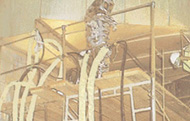
VIP technicians enter the hot converter wearing specially
designed heat resistance acid suits that are supplied with
cooled breathing air and are equipped with radios that allow
them to communicate with technicians outside the converter.
Technicians vital signs, the temperature of the suits
and the temperature of the converter are constantly monitored
by a life support system positioned outside. In addition,
each suit is fitted with a triple backup breathing system.
Each technician is trained first on how to work in "inert"
atmospheres, or oxygen-deficient environments, and then given
the skills to work in high temperatures.
"Only our most experienced vessel entry technicians
are allowed to do high temp work," Miller said. "They
are brought into it very slowly, in the classroom and in the
field. It is dangerous, but we know what were doing.
And were proud of the fact that weve never had
a safety incident on a high temperature job."
George
Carpenter, superintendent of the IMC-Agrico Uncle Sam plant
in Louisiana, said high temperature entry is a valuable service,
adding that timing is very important.
Carpenter learned firsthand when the deflector baffle fell
into the catalyst bed in the first pass of his converter.
The velocity blew the rock and catalyst from around the baffle
to expose the grates in a horseshoe shape.
VIP entered the converter under high temperature conditions,
hoisted and welded the baffle back into place and leveled
the catalyst bed. The converter was still far too hot for
normal entry when the work was complete.
Using high temperature technicians, VIP can repair a fallen
grate in about four hours, skim a 60,000 liter catalyst bed,
and reload it in about 16 hours; or completely remove and
replace an entire first bed in less than 48 hours.
"And their converter should never drop below about 300
degrees ." Maddry said.
(Reprinted from Sulfuric
Acid Today November 1994 issue.)
|