VIP
International credited with quick ASARCO turnaround
ASARCO Inc., El Paso, Texas facility is over a hundred years
old and is one of the oldest in the nation for copper smelting.
However, the old is combined with the new in helping this facility
meet strict environmental requirements.
The El Paso facility, situated in a valley inhabited by nearly
two million people, was originally built to handle ore from
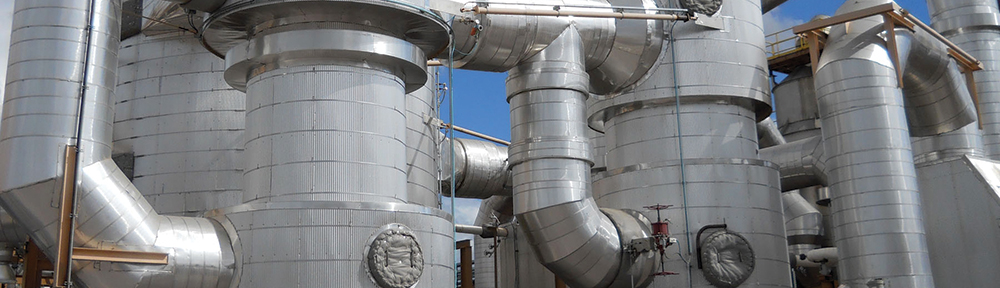
Mexico. The facility consists of two sulfuric acid plants, a
1972 Lurgi and a 1978 Monsanto.
According to Fred Scott, acid supervisor at the El Paso
facility and a 31-year veteran of the sulfuric acid industry,
state emission standards are going to get more stringent.
"The amount of sulfur dioxide that facilities are allowed
to emit into the atmosphere is going to get a lot stricter,"
he said. "Some of the new sulfuric acid plants have bigger
preheaters that can take the entire capacity of the plant
as they can heat up all of their beds, leaving virtually no
tail gas."
Currently, if a plant's sulfuric acid emissions exceed 600
parts per million, it is shut down. Scott said this is a big
concern because the materials and cost of operations are going
to be astronomical.
"The size of the equipment, the amount of catalyst in
the beds and the maintenance are going to be very critical,"
Scott explained. "If you lose a heat exchanger due to
a few leaking tubes, for example, the amount of tail gas is
going to shut your plant down."
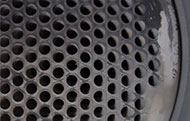
There are some simple tests that can be run across heat exchangers
to determine leaks. However, these conventional tests are
not perfect and have been known to miss leaks.
With the help of the latest in acoustic emission monitoring
equipment, heat exchanger leaks can now be found quickly and
precisely with very little downtime.
"With the acoustic emission monitoring equipment, we
can check 2,000 tube units in 15 minutes and determine which
tubes are leaking and need to be plugged," Scott explained.
"But in order to enter the exchanger, it must be cooled
to ambient temperature which can take from 24-hours to 36-hours."
Because it takes such a long time to cool down a heat exchanger,
Scott said they brought in VIP International to save the downtime
with its high temperature entry process.
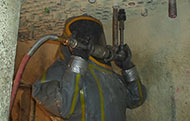
With VIP's process, a heat exchanger only needs to be cooled
to 550 degrees Fahrenheit from its original 850 degree temperature.
VIP is the only company providing this service to sulfuric
acid plants.
Scott said it takes approximately six hours to cool a heat
exchanger to 550 degrees, at which time a VIP International
crew was able to locate and plug leaking exchanger tubes while
the plant was still hot.
"VIP's process saves us a lot of time," Scott said.
"On a recent turnaround, VIP used the acoustic emission
equipment to spot leaks immediately and we did not have to
pressure test each tube. With this acoustic emission equipment,
you can pick up the sounds of leaking tubes and have them
all identified within 20 minutes," Scott added.
VIP's high temperature entry was used to eliminate the exchanger
cooling process, which can take several days. Once the exchanger
was cooled, a very time- and cost-consuming pressure test
was required to check for leaking tubes, sometimes up to 2,000
of them.
"The advantage of VIPs high temperature entry
and the use of acoustic emission equipment is that it flat
out saves time and money," David "Hoss" Maddry,
VIP International vice president, said. "Another advantage
of VIPs acoustic emission leak detection program is
that we can detect leaks in the tube sheet also."
To check a leaking tube sheet conventionally requires pressure
testing the whole vessel or using a dye penetrant, a time
consuming process. Maddry explained conventional methods result
in lost time and production, while VIP's methods limit downtime
and are more efficient at locating tube and tube sheet leaks.
In addition to dealing with 550 degree temperatures and the
need to expedite tube leak repair, VIP technicians must also
systematically inspect and identify nearly 2,000 tubes per
vessel entry.
"We have to have good communication in order to perform
our mission well," Mark Thompson, VIP superintendent
on the ASARCO turnaround, said. "In order to remove confusion
when dealing with a few thousand tubes, we make a concise
blueprint of the vessel."
Using the blueprint, VIP crews identify a reference point
within the vessel to easily coordinate tube leak identification.
Thompson explained that the crew in the vessel inspects each
tube and delays their findings to a console operator who relays
that same information to a man on the top of the exchanger.
The man on top of the exchanger, who also has a blueprint
of the vessel, then plugs any tubes that have been found to
be leaking.
To do such an astronomical task is not easy. Through the
use of proper equipment and a high degree of training, VIP
International crews are able to enter high temperature vessels
safely.
Stanley "Bubba" Miller, operations manager of VIP
International, was a co-developer of high temperature entry
in 1981.
"We originally developed this capability so we could
repair broken or fallen grates as well as doing emergency
catalyst screening in high temperatures," Miller said.
"Normally it takes 24 to 48 hours to cool a convertor
to ambient temperature, but it only takes four hours to cook
it so we can enter. From there it was a natural fit to move
into another high temperature scenario," he added.
With the combination of technology - acoustic emission monitoring
equipment and high temperature entry capabilities - VIP International
is able to save sulfuric acid plants time and money.
"VIP has definitely found a better way to find exchanger
leaks and cracks," Scott said.
|